The History of the Canyon Dam and Reservoir
Construction of Canyon Dam on the Guadalupe River
Mile 303 began in 1958. It was constructed to serve
two purposes - flood control and water conservation.
Flood protection is provided to 157,250 acres of land
downstream from the dam. The high canyons of the upper
Guadalupe have a channel capacity of 40,000-50,000
cubic feet per second. The channel on the lower Guadalupe
River has a capacity of only 13,000-30,000 cubic feet
per second; therefore, the lower Guadalupe River Basin
had been especially subject to serious flooding. The
construction of Canyon Dam on the edge of the Balcones
Escarpment has been very effective in protecting the
lower Guadalupe River Basin. One example of this came
in August 1978. Within two days' time, 40 inches of
rain fell on the upper Guadalupe River. The river
flowed into the lake at 115,000 cubic feet per second
causing the lake to rise 21.6 feet above the conservation
pool level of 909.0 feet above mean sea level. It
was estimated that 24 million dollars of downstream
damage was averted due to the flood protection of
Canyon Dam.
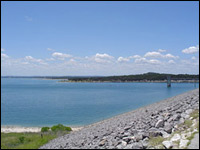
At conservation pool level the lake has a capacity
of 382,000 acre-feet. It has a surface area of 8,230
acres and 80 miles of shoreline. At flood control
pool level of 943-ft msl, the lake has an additional
capacity of 346,000 acre-feet making total storage
728,400 acre-feet.
Water impoundment began in 1964 and the conservation
pool level was reached in 1968. To date, it has been
estimated that millions of dollars in flood damage
has been averted from several major flood events in
the area.
Lake Levels
- 909.0 ft msl - conservation pool
- 943.0 ft msl - spillway crest
- 948.0 ft msl - spillway crest, plus 5 feet spillway
flow-high elevation of flowage easement lands
- approx. 893.11 ft msl - all time lowest lake pool in September of 2009
- 950.32 ft msl - all time highest lake pool after
impoundment on July 6, 2002
Early Settlement
The earliest European settlements along the Guadalupe
were Spanish missions, but none of them survived.
In 1726 Franciscan friars moved the Mission Espiritu
Santo de Zuniga from Matagorda Bay to a bluff overlooking
the Guadalupe near present day Victoria. They tried
to build and maintain a dam to divert water from the
River to irrigated fields, but they abandoned the
effort in 1736. In 1755 and 1756 missions were established
at the two locations where large springflows provided
a constant source of flow for the Guadalupe, San Marcos
Springs and Comal Springs, but those missions also
failed.
In 1808 an attempt by 80 people to construct a permanent
settlement near present day Gonzales was defeated
by Indian raids and floods. The first successful permanent
settlement occurred in 1824 when Martin de Leon received
an empresario grant to colonize lands in the lower
Guadalupe Valley and founded the city of Victoria.
The following year, Green de Witt from Kentucky obtained
a grant to settle 400 families and founded the town
of Gonzales.
By 1850 two other settlements, Seguin and New Braunfels,
were also becoming important in the Guadalupe Valley
as centers of trade and population.
The scenic beauty of the Valley attracted many, and
the promise of economic opportunities afforded by
the River convinced them to stay.
Cattle, cotton, timber, and oil were economic mainstays,
and between 1850 and 1900 the population increased
ten-fold from 9,300 to over 100,000.
Information courtesy of the US Army Corps of Engineers
and the Edwards Aquifer.
Recreation
Canyon Lake is located about an hour's drive north
of San Antonio and an hour south of Austin on the
edge of the beautiful Texas Hill Country.
Canyon Lake includes all forms of boating especially
sailing, water-skiing, and use of personal watercraft.
Canyon Lake has 22 public boat ramps conveniently
placed around the lake in coves or on peninsulas.
Canyon Lake has long been popular among SCUBA divers
due to its clear deep waters. SCUBA diving is especially
popular at North Park and Overlook Park.
Eight public parks are operated by the US Army Corps
of Engineers for all to enjoy the scenery and the
cool clear waters of Canyon Lake.
Comal County - The county operates eight public boat
ramps at Canyon Lake all on public roads in area subdivisions.
These ramps have 24-hour a day access. Comal County
has also recently obtained a lease for a large area
below the dam. The area is being developed for the
Hidden Valley Sports Complex which will provide baseball
fields, football fields, soccer fields and a large
multi-purpose building for the recreational needs
of Comal County citizens and others.
Military Retreat Areas - Both Ft. Sam Houston and
Randolph AFB have developed areas at Canyon Lake for
use by military personnel, retirees and their dependents.
Their facilities include marinas, swim beaches, boat
and trailer rentals, campsites and picnic sites. Click
on the highlighted words above for more information.
Marinas are available at Canyon Park, Cranes Mill
Park and at the Lake Canyon Yacht Club Click the anchor
for more information about the marinas.
Fishing is probably the most popular activity at
the lake. Besides bank fishing in the park areas,
a fishing dock is available at Cranes Mill Park and
is open 24 hours every day of the year. Just downstream
from Canyon Dam, a fishing platform along the north
bank of the Guadalupe River as well as a trail along
the south bank makes free public fishing access on
the river always available.
The majority of fishing is centered on largemouth
bass, striped bass, white bass, crappie, and catfish.
The reach of the reservoir upstream from Cranes Mill
Park is very popular with anglers year-round. It is
accessible only by boat. Each Winter season, the Texas
Parks and Wildlife Department stocks rainbow trout
in the tailrace below Canyon Dam for licensed fishers
who hold a Freshwater Fishing Permit.
Trails at Canyon lake include a walking trail at
the Canyon Dam Crest Road in Overlook Park. The North
and South (ADA accessible) Guadalupe River fishing
trails are located just below the dam. The Old Hancock
Road Hike/Bike/Equestrian Trail is a 3.5 mile trail
on the north lakeshore. Click on the highlighted words
above for more information on the trails.
Hikers and bikers have also discovered Canyon Lake
as a place for fun and relaxation.
Contact
Me Today:
Redgie Ewoldt
Phone: 210-844-5778
Email: redgie@gvtc.com
|